Abstract
In 2021, China released the “Double Reduction” policy and the “Promoting Home Education Law”, both emphasizing providing parenting guidance through family-school cooperation. However, parents’ needs for guidance and what factors influence their needs are unclear, posing barriers to the implementation of the national initiatives by schools and teachers. To explore parents’ needs for parenting guidance and the influencing factors on them, this study investigated 28 parents of low-grade pupils in Hailar, China, about their needs using semi-structured interviews, and surveyed 18 of them about their parenting styles and their children’s temperament using the Parenting Style Scale and the Children’s Temperament Scale. Qualitative analysis showed that parents demonstrated three needs for parenting guidance: schools and teachers optimizing feedback on tests, head teachers providing guidance while schools managing provision, and parents receiving help with improving parent-child communication skills. Quantitative analysis found associations between parents’ needs for parenting guidance and the parenting styles of rejection and overprotection. Parents’ gender, the number of their children’s siblings, and their children’s mood temperature were found to moderate the relationships between parenting styles and parents’ needs for parenting guidance. These findings provide important implications for further research in parenting guidance and family-school cooperation, as well as for practical work in schools, especially for school teachers to provide instruction for parents to educate their children according to the students’ and parents’ characteristics.
Keywords
Parenting Styles, Needs for Parenting Guidance, Moderation, Parents, Children
1. Introduction
In 2021, China released two important educational initiatives, the “Double Reduction” policy (
Reducing Students’ Homework and Shadow Education Burdens in Compulsory Education Stage) and the “Promoting Home Education Law”, both emphasizing children’s healthy development. These two documents required providing parenting guidance for parents, and schools and teachers to help with guidance provision through family-school cooperation
| [1] | General Office of the Communist Party of China Central Committee, General Office of the State Council, “Initiative of Further Reducing Student’ Academic Burden of Homework and Shadow Education of in Compulsory Education. Available from: https://www.gov.cn/zhengce/2021-07/24/content_5627132.htm (Accessed 11 September 2025). |
| [2] | The National People’s Congress. “Family Education Promotion Law of the People’s Republic of China”. Available from: http://www.npc.gov.cn/npc/c30834/202110/8d266f0320b74e17b02cd43722eeb413.shtml (Accessed 11 September 2025). |
[1, 2]
.
In fact, during the long evolution of academic burden reduction policies in China, parents have taken on increasing responsibilities in the education of children, accumulating a large amount of confusion, anxiety, and other emotions in parenting, demonstrating multiple needs for parenting guidance (NPG). This problem is still prominent today. Due to parents’ different educational backgrounds, growth environments, and economic conditions, they may have different educational philosophies, styles, and methods for their children. When they have high expectations or face educational anxiety, or even feel disappointed in educating their children, if they do not receive timely and effective parenting guidance, they may be helpless and even blindly adopt unscientific educational methods to parent their children, resulting in damage to their children’s physical and mental health
. This indicates the importance of carrying out parenting guidance.
Meanwhile, although the significance and value of family-school cooperation in instructing home education are constantly recognized and emphasized, the problem of the mismatch between the functions of home education and school education is highlighted, and family-school cooperation is facing challenges in distributing responsibilities. Due to the insufficient grasp of the essence and connotation of home education by schools, the guidance and intervention from schools in home education lack rationality
. The manifestation of this problem can be seen as: the parenting guidance provided by schools and teachers may not necessarily be accepted and cooperated with by parents, while parents’ NPG may not necessarily be recognized and responded to by schools and teachers. This situation still falls short of the expectations and requirements of the “Double Reduction” policy and the “Promoting Home Education Law” for the development of parenting guidance through cooperation between families and schools, and hinders the implementation of these initiatives
| [4] | Liang, W. Appeals of Parents in Lower Grade of Primary School for Family Education Guidance in the “Double Reduction” Context: Based on Family-School Cooperation. M.Ed. Thesis, Liaoning Normal University, 2025. |
[4]
.
Based on the above argument, it can be seen that understanding parents’ NPG through family-school cooperation is beneficial. However, parents’ NPG and what factors influence their needs are unclear, posing barriers to schools and teachers conducting parenting guidance and family-school cooperation
| [4] | Liang, W. Appeals of Parents in Lower Grade of Primary School for Family Education Guidance in the “Double Reduction” Context: Based on Family-School Cooperation. M.Ed. Thesis, Liaoning Normal University, 2025. |
[4]
. A previous questionnaire survey has found that parents have questions about supporting children’s physical and mental health and academic performance, and they need guidance for these issues
| [5] | Zhang, X., Zhang, S., Wang, M., Xu, Z., Zhou, M. Demand and Turn of Family Education Under the “Double Reduction” Policy: Based on a Survey of 3563 Families in Shanghai. Research in Educational Development. 2023, 43(20), 67-76. https://doi.org/10.14121/j.cnki.1008-3855.2023.20.004 |
[5]
. However, each parent, child, and question demonstrates unique characteristics
| [3] | Liu, S. The Changes of Times, Difficulties in Reality and Choice of Approaches in Family Education. Education Research Monthly. 2023(01), 44-49.
https://doi.org/10.16477/j.cnki.issn1674-2311.2023.01.010 |
| [6] | Qian, J., Chen, H. Family Education Guidance: Urgent Need for Personalization and Scientification. Educational Science Research. 2018, (05), 18-20. |
[3, 6]
, resulting in different parents’ different NPG, which the survey has not dug out, yet. A specific NGP is related to parents’ characteristics, their children’s characteristics, and their family characteristics. For instance, parents adopting different parenting styles (PS) may cause different family education confusion and corresponding NPG
| [4] | Liang, W. Appeals of Parents in Lower Grade of Primary School for Family Education Guidance in the “Double Reduction” Context: Based on Family-School Cooperation. M.Ed. Thesis, Liaoning Normal University, 2025. |
[4]
. Another example is that children’s temperament may also affect parents’ confusion in parenting and corresponding NPG, because previous studies have found that children’s temperament determines the difficulty of raising them
| [7] | Perris, C., Jacobsson, L., Linndström, H., von Knorring, L., Perriset, H. Development of a new inventory for assessing memories of parental rearing behaviour. Acta Psychiatrica Scandinavica. 1980, 61(4), 265-274.
https://doi.org/10.1111/j.1600-0447.1980.tb00581.x |
| [8] | Jiang, J., Lu, Z., Jiang, B., Xu, Y. Revision of the Short-form Egna Minnen av Barndoms Uppfostran for Chinese. Psychological Development and Education. 2010, 26(01), 94-99. https://doi.org/10.16187/j.cnki.issn1001-4918.2010.01.017 |
[7, 8]
. Given that previous research exploring the relationship between parents’ NPG and their PS is descriptive and speculative, empirical evidence for regularities in the specific relationship and the impacts of parents’ and children’s factors on this relationship has not been discovered yet. This gap impedes schools and teachers’ practical work in parenting guidance and family-school cooperation corresponding to students and their parents’ characteristics.
Against this background, this study used a mixed method to explore the relationship between PS and NPG and the potential moderating effect of parents’ and children’s characteristics.
2. Method
2.1. Interviews
2.1.1. Participants
Participants were recruited using convenience sampling and snowball sampling. 28 parents of low-grade students in primary schools in Hailar, China, participated in the interviews.
2.1.2. Procedures
Semi-structured interviews were conducted face-to-face or using voice calls between May 2024 and January 2025. Before the interviews, the participants were provided with the consent form, which introduced the research aim and the anonymity of the interviews. Interviews were started only after obtaining participants’ consent. All the participants were told that they could withdraw from the interview at any time for any reason. No participant withdrew from the interview or retracted consent. During interviews, participants were asked about their NPG.
2.1.3. Qualitative Data Analysis
The interviews were transcribed verbatim and anonymized in the recorded documents. All interview records were imported individually into NVivo 15 and were coded and analyzed drawing on Liang and Zhang’s multi-level coding method and mixed analysis method
| [9] | Liang, W., Zhang, Y. The Correlation between Sadomasochists' Experience and Their Sadomasochistic Behaviors and fantasies: A Qualitative Analysis of Interviews. PsyCh Journal. 2024, 13(2), 295-321.
https://doi.org/10.1002/pchj.706 |
[9]
. The final kappa coefficients of the codes were 0.8142 or higher.
2.2. Questionnaire Survey
2.2.1. Sample
Among the 28 interviewees, 18 further participated in the questionnaire survey, providing information about their PS and their children’s temperament. These 18 participants formed the sample of this study.
2.2.2. Measure
The questionnaire was used to collect the participants’ PS and their children’s temperament. It is composed of two scales - the Parenting Style Scale and the Children’s Temperament Scale. The reliability and validity of both scales have been proven to meet the requirements of psychometric indicators
| [7] | Perris, C., Jacobsson, L., Linndström, H., von Knorring, L., Perriset, H. Development of a new inventory for assessing memories of parental rearing behaviour. Acta Psychiatrica Scandinavica. 1980, 61(4), 265-274.
https://doi.org/10.1111/j.1600-0447.1980.tb00581.x |
| [8] | Jiang, J., Lu, Z., Jiang, B., Xu, Y. Revision of the Short-form Egna Minnen av Barndoms Uppfostran for Chinese. Psychological Development and Education. 2010, 26(01), 94-99. https://doi.org/10.16187/j.cnki.issn1001-4918.2010.01.017 |
| [10] | Zhang, J. Test Report on NYLS “Temperament Scale for Children Aged 3-7”. Chinese Journal of Mental Health. 1995, (05), 203-205+208+239. |
| [11] | Ding, T., Ni, J., Xu, J., Shen, J., Ye, G., Chen, L., Liu, X. Investigation of Social Competence and temperament type in Preschool Children in Shanghai Chongming District. Journal of Clinical Pediatrics. 2014, 32(06), 551-554.
https://doi.org/10.3969/j.issn.1000-3606.2014.06.013 |
[7, 8, 10, 11]
. The Parenting Style Scale was used to investigate the PS used by the participants, including the degree to which parents use overprotection (OP), emotional warmth (EW), and rejection (RJ) towards their children. Among these dimensions, overprotection refers to overly worrying and intervening in children, emotional warmth refers to encouraging and caring for children, and rejection refers to criticizing, accusing, and punishing children
| [7] | Perris, C., Jacobsson, L., Linndström, H., von Knorring, L., Perriset, H. Development of a new inventory for assessing memories of parental rearing behaviour. Acta Psychiatrica Scandinavica. 1980, 61(4), 265-274.
https://doi.org/10.1111/j.1600-0447.1980.tb00581.x |
| [8] | Jiang, J., Lu, Z., Jiang, B., Xu, Y. Revision of the Short-form Egna Minnen av Barndoms Uppfostran for Chinese. Psychological Development and Education. 2010, 26(01), 94-99. https://doi.org/10.16187/j.cnki.issn1001-4918.2010.01.017 |
[7, 8]
. Meanwhile, the Children’s Temperament Scale was used to investigate the temperament characteristics of the participants’ children, including their rhythmicity (RT), approach and withdrawal (AW), adaptability (AD), reaction intensity (RI), mood (MD), etc. Rhythmicity refers to the regularity of children’s repetitive physiological functions, such as sleep, diet, and defecation; approach and withdrawal refer to the initial response to new stimuli, such as new food, new toys, strangers, or new situations; adaptability refers to the process of accepting new things and situations (e.g., whether it is easy or difficult to adapt when traveling or going to kindergarten for the first time); reaction intensity refers to the intensity of the response to a stimulus (e.g., whether it is intense as crying loud or a milder reaction when encountering the stimulus); mood refers to the proportion of happy, harmonious, and friendly behaviors versus unpleasant, unpleasant, and unfriendly ones (e.g., the emotional state when playing with children)
| [10] | Zhang, J. Test Report on NYLS “Temperament Scale for Children Aged 3-7”. Chinese Journal of Mental Health. 1995, (05), 203-205+208+239. |
| [11] | Ding, T., Ni, J., Xu, J., Shen, J., Ye, G., Chen, L., Liu, X. Investigation of Social Competence and temperament type in Preschool Children in Shanghai Chongming District. Journal of Clinical Pediatrics. 2014, 32(06), 551-554.
https://doi.org/10.3969/j.issn.1000-3606.2014.06.013 |
[10, 11]
. These temperament traits are closely related to the difficulty of parents raising their children
| [10] | Zhang, J. Test Report on NYLS “Temperament Scale for Children Aged 3-7”. Chinese Journal of Mental Health. 1995, (05), 203-205+208+239. |
[10]
. Therefore, the scores of these five dimensions will be calculated to test their moderating effect.
2.2.3. Quantitative Data Analysis
Scores of PS and children’s temperament were analyzed using SPSS 23.0. Given the small sample size (n<30), the Spearman rank correlation coefficient method was used to test the correlation between the scores of each dimension of the participants’ PS and the numbers of level-2 node reference points (RPs) extracted from the qualitative analysis of interviews. The moderation roles of parents’ gender, age range, education, expectation of their children’s education level, as well as their children’s gender, grade, number of siblings, academic performance, and temperament were tested using the PROCESS plugin.
3. Results
3.1. Parents’ NPG
During the qualitative analysis process, three themes extracted were “schools and teachers optimizing feedback on tests,” “head teachers providing guidance while schools managing provision,” and “parents receiving help with improving parent-child communication skills,” indicating three different typical NPG of the participants.
3.1.1. NPG1 - Schools and Teachers Optimizing Feedback on Tests
The first theme extracted was “schools and teachers optimizing feedback on tests,” the RPs of which occupied 31.67%. According to the content of this theme, some participants talked about how the schools arranged frequent tests and published the number of students in each score range or even the ranking of grades, which made them dissatisfied. In this situation, parents could feel a lot of pressure and anxiety. Even if the school followed the “Double Reduction” policy and did not assign written homework for students to complete at home, parents still tended to fill their children’s free time with the homework they assigned after their kids came home. Under this test feedback method, parents needed certain guidance to help them correctly understand the test feedback results and take scientific actions to solve the problems reflected in the test feedback results.
3.1.2. NPG2 - Head Teachers Providing Guidance While Schools Managing Provision
“Head teachers providing guidance while schools managing provision” was the second extracted theme, and the RPs accounted for 33.14%. Participants in this study demonstrated a strong need for the school to organize head teachers to provide parenting guidance. They trusted the school to manage guidance services mainly because they trusted the guidance provided by head teachers. According to the content of this theme, the participants believed that head teachers knew their children best and were therefore most aware of the problems in their family education. However, at the same time, the participants also believed that school teachers, especially head teachers, had limited energy and faced great work pressure. They did not think that it was realistic for head teachers to be responsible for parenting guidance services, even though they really expected this.
3.1.3. NPG3 – Parents Receiving Help with Improving Parent-Child Communication Skills
The third theme, “parents receiving help with improving parent-child communication skills,” contained 13.28% of the extracted RPs. Participants had strong needs for improving parent-child communication through parenting guidance. According to the content of this theme, participants’ need for guidance in parent-child communication mainly involved how to understand their children’s true thoughts and how to control their own temper. They felt uneasy grasping their children’s true thoughts and worried that their bad temper would worsen their communication with their children.
3.2. Correlation Between NPG and PS
Correlation analysis of the numbers of RPs of the themes and scores of the three dimensions of PS was conducted to explore the relationship between parents’ NPG and their PS. The results are shown in
Table 1.
Table 1. Correlation between needs for parenting guidance and parenting styles.
| RJ | EW | OP |
NPG1 | -.586* | .349 | -.215 |
NPG2 | .518* | -.208 | .539* |
NPG3 | .474* | -.104 | .309 |
*. p<.05.
Table 1 shows that participants’ rejection style was significantly negatively correlated with their needs for schools and teachers optimizing feedbacks of tests (
r=-. 586,
p<. 05), and significantly positively correlated with their needs for head teachers providing guidance while schools managing provision (
r=. 518,
p<. 05) and receiving help with improving parent-child communication skills (
r=. 474,
p<. 05). Meanwhile, participants’ overprotection style was significantly positively correlated with their needs for head teachers providing guidance while schools managing provision (
r=. 539,
p<. 05). Additionally, participants’ PS of emotional warmth was not significantly correlated with their guidance needs.
3.3. Moderation by Parents and Children’s Characteristics
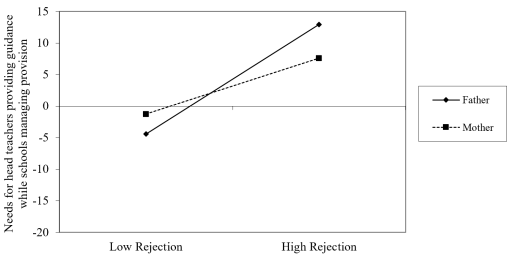
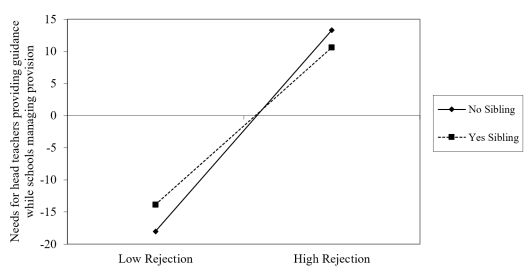
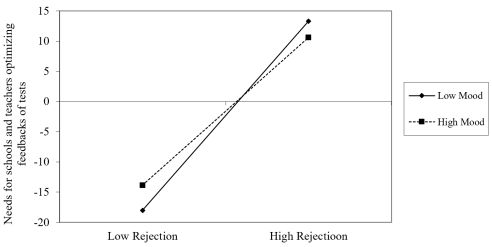
Three significant moderation roles played by children’s mood (MD), parents’ gender (PG), and the number of children’s siblings (CS) were found during moderation tests, as shown in
Table 2. The interactions between PS and the moderators in predicting NPG are shown in
Figure 1,
Figure 2, and
Figure 3.
Table 2. Significant moderation by parents’ and children’s characteristics.
y | | β | t | Bootstrap 95%CI |
LLCI | LLCI |
NPG1 | RJ | 42.3416 | 2.2151 | 1.3395 | 83.3438 |
| MD | 15.1323 | 2.5922 | 2.6101 | 27.6545 |
| RJ×MD | -9.2675 | -2.3121 | -17.8653 | -.6697 |
R2 | .5409 |
F | 5.4979* |
NPG2 | RJ | 23.4618 | 3.8635 | 10.4355 | 36.4881 |
| PG | 16.7385 | 3.2996 | 5.8568 | 27.6208 |
| RJ×PG | -11.4618 | -3.6198 | -18.2541 | -4.6696 |
R2 | .5783 |
F | 6.3985** |
NPG2 | RJ | 11.0228 | 2.8782 | 2.8078 | 19.2378 |
| CS | 5.0522 | 1.4937 | -2.2031 | 12.3074 |
| RJ×CS | -4.9180 | -2.2751 | -9.5548 | -.2811 |
R2 | .6006 |
F | 7.0171** |
*. p<.05, ** p<.01.
Figure 1. Interaction between rejection and parent gender predicting needs for head teachers providing guidance while schools managing provision.
Figure 2. Interaction between rejection and number of children’s siblings predicting needs for head teachers providing guidance while schools managing provision.
Figure 3. Interaction between rejection and mood predicting needs for schools and teachers optimizing feedbacks of tests.
From
Figure 1 and
Figure 2, it can be seen that a low level of rejection style predicted a low level of needs for head teachers providing guidance while schools managing provision, while a high level of rejection style predicted a high level of the needs. Meanwhile, the prediction was stronger among fathers and parents with only one child, and weaker among mothers and parents with more than one child.
Figure 3 demonstrates that a low level of rejection style predicted a low level of needs for schools and teachers optimizing feedback on tests, while a high level of rejection style predicted a high level of the needs. Meanwhile, the prediction was stronger among parents with low-mood children and weaker among parents with high-mood children. Comparing the findings in
Figure 3 and those of correlation analysis, it can be seen that the interaction between parents’ rejection style and children’s temperament of mood suppressed the positive correlation between parents’ rejection style and their needs for schools and teachers optimizing test feedback
.
4. Discussion
4.1. Parents’ Three NPG
4.1.1. Needs for Schools and Teachers Optimizing Feedback on Tests
The present study found that parents needed help with correctly understanding the test feedback and rationally responding to the problems reflected in the feedback. There have been few in-depth studies analyzing the impact of school tests and exams on parents’ implementation of the “Double Reduction” policy and their NPG. However, it can be understood that when schools and teachers provide feedback on students’ test and exam results to parents, they often involve explanations and corresponding suggestions for parents. This is apparently a form of family education guidance. Therefore, exam feedback is indeed related to parents’ NPG. If the parents’ needs cannot be resolved, the existing exam feedback method will mainly reinforce parents’ educational anxiety, which is not conducive to promoting parents’ implementation of the “Double Reduction” policy, nor is it conducive to parents’ reasonable parental intervention in their children’s study. This is inconsistent with the expectations of the “Double Reduction” policy.
4.1.2. Needs for Head Teachers Providing Guidance While Schools Managing Provision
This study found that parents had a strong need for the school to organize head teachers to provide parenting guidance because they knew the students the best. Meanwhile, parents believed that it was not realistic because head teachers were allocated a heavy workload and thus under great work pressure.
Previous studies have generally agreed that schools are the most closely connected and trusted entities with parents, with teachers being the most familiar with students’ specific situations. Therefore, schools and teachers are the most advantageous entities in providing parenting guidance in terms of convenience
| [13] | Dong, H. Family-School Collaborative Education under the Background of “Double Reduction”. Journal of the Chinese Society of Education. 2021(S2), 196-199. |
| [14] | Dou, Y., Qiao, D. Top-Level Design and Implementation Strategy of Family Education Guidance Service System from the Perspective of “Family-School-Community Collaboration”. 2023, (01), 34-39+74. |
| [15] | Ma, S., Xin, Z. Family Education Guidance in Schools in the Context of Home-School-Society Co-operation: Necessity, Feasibility and Limitations. Forum on Contemporary Education. 2025, (01), 47-54.
https://doi.org/10.13694/j.cnki.ddjylt.20241031.001 |
[13-15]
. Further, researchers suggested that primary and secondary schools had a large team of teachers who could quickly transform into instructors for parenting guidance through short-term vocational training
and efforts should be made to improve guidance abilities in four aspects: value recognition, training programs, institutional culture, and platform construction, forming a new mechanism for cultivating teachers’ parenting guidance capabilities based on the integration of government leadership, school subjectivity, social participation, and family empowerment
| [16] | Liu, H., Chen, J., Zhao, M. Teacher’s ability to Guide Family Education and Its Cultivation. Journal of the Chinese Society of Education. 2024, (06): 90-95. |
[16]
. Specifically, researchers suggested starting from the policy and administration system design, and integrating parenting guidance work into the high-quality development and construction of schools. Examples of strategies include parenting guidance work as an indicator in the management and assessment of teachers’ workload and performance, as well as assisting in teachers’ balancing teaching and parenting guidance work
| [17] | Yang, L., The Dilemma and Breakthrough of Schools Providing Guidance Services for Family Education. Teaching & Administration. 2024, (07), 16-20. |
[17]
. It seems that the strategies advocated by existing research are consistent in direction with the parents’ needs discovered in this study.
However, it is worth noting that even parents do not consider these strategies feasible. According to the findings of this study, parents believe that teachers are very busy and under great pressure. This belief was only from participants’ daily interactions with them, let alone the truth. Parents also believe that many teachers themselves are parents, have families, and children. Even if the school does organize and manage parenting guidance by teachers, they may not be able to take on any additional work. How to meet the expectations of parents that schools should organize teachers, especially head teachers, to provide parenting guidance with authority and credibility, while taking practical and feasible measures, is an urgent problem that needs to be solved. Regarding this, researchers have proposed to shift the cultivation of teachers’ parenting guidance ability forward – into pre-service training
| [16] | Liu, H., Chen, J., Zhao, M. Teacher’s ability to Guide Family Education and Its Cultivation. Journal of the Chinese Society of Education. 2024, (06): 90-95. |
[16]
. However, previous studies have not proposed specific strategies for this idea, and teachers who have participated in pre-service training will still become busy with work after starting their career. Thus, the problem of teachers not having time to guide remains unresolved. In this study, a small number of participants mentioned having intern teachers in their children’s classes and expressed trust in them observing problems in their children and the parenting advice they provided. These participants believed that Grade-1 and Grade-2 students were “simple” and problems of parenting reflected on them could be easily discovered through short-term interactions. Based on this view, arranging the pre-service training of teachers’ parenting guidance ability in education and teaching contexts may be a worthwhile idea to consider. As such, they not only possess relevant professional knowledge and skills, but also have a certain familiarity with students as officially employed head teachers do, and can help reduce head teachers’ workload.
4.1.3. Needs for Parents Receiving Help with Improving Parent-Child Communication Skills
The third theme of NPG found in the participants was parents receiving help with improving parent-child communication skills to establish a healthy parent-child relationship. This reflects parents’ desire for personal growth. According to the participants, they tended to make regulations and demands on their children’s daily lives and study from their own perspective, which is not a “warm family ecology.” The participants hoped to better understand their children’s positions and provide them with a warmer family atmosphere.
In recent years, research has advocated that, under the background of “Double Reduction,” education in a family should achieve a humanistic return and create a warm parent-child relationship
, and guide parents to make “companionship, reading, and habits” the key communication concepts during parenting
| [18] | Jia, W., Q, Chen., Cai, Q. Does Homework Anxiety for Parents Still Exist in the Background of “Double Reduction”: An Empirical Study of 1648 Parents in 9 Districts of City Based on Grounded Theory. China Educational Technology. 2023, (05): 95-104. |
[18]
. It can be seen that this found need is also supported by existing studies, and is supposed to be responded to by parenting guidance work.
4.2. Correlation Between NPG and PS of Rejection and Overprotection
According to the correlation analysis, parents who are more inclined to use criticism, blame, and punishment to raise their children are more eager for head teachers to provide guidance on parenting, and are more likely to face parent-child communication problems. Conversely, parents who are less inclined to adopt this PS tend to place more emphasis on family-school communication regarding their children’s homework and tests. It is likely that the rejection style causes a higher level of parenting problems and parent-child communication barriers, while the non-rejection style leads parents to seek external resources to help educate their children, which potentially reduces the possibility of parenting problems and parent-child communication barriers. Meanwhile, parents who tend to excessively focus on and intervene in their children are also more eager for the head teachers to provide guidance on parenting. On the contrary, parents who less focus on and intervene in their children show fewer needs for guidance from head teachers. A possible explanation might be that turning to teachers for help with parenting is one of the manifestations of the parents’ overprotection style. Teachers’ guidance aligns with their intentions to protect their children to the level they are satisfied with.
To date, existing studies have barely explored the correlation between NPG and PS, indicating that the findings of this study need to be further explored and examined by future studies. Particularly, the negative correlation between rejection style and needs for schools and teachers optimizing feedback on tests was found to be the result of suppression of the positive correlation between them by children’s mood, which is very worth further exploring and testing in the future. Still, the correlations found in this study are considerably enlightening. These regularities will help head teachers or other parenting guidance instructors quickly detect when parents may have adopted inappropriate parenting methods towards their children, such as excessive criticism, blame, punishment, or excessive protection, based on the strong needs of parents for parenting guidance from head teachers and other instructors, or the difficulties they face in parent-child communication. As such, the head teachers or instructors can provide tailored parenting guidance for the parents. Likewise, these findings will also help parenting guidance instructors to effectively identify potential communication issues between parents and children, as well as parents’ neglect of cooperation with teachers in assisting children’s study based on their observations of parents’ refusal and overprotection. This will enable them to timely anticipate parents’ needs for parenting guidance and provide corresponding help for the parents.
4.3. Moderation by Parents’ Gender, Children’s Mood, and Number of Siblings
Firstly, this study found that rejection style positively predicts needs for head teachers providing guidance while schools managing provision, and the prediction is stronger among fathers and parents with only one child. On one hand, this is likely because mothers, who play a more important role in parenting in China
| [19] | Tang, Y., Motherhood Anxiety and Fathers’ Involvement in Parenting: A Qualitative Study of Middle-Class Families in Shenzhen. Journal of Shenzhen University (Humanities & Social Sciences), 2021, 38(06): 101-113. |
[19]
, are better at getting along and communicating with children compared to fathers. With regard to fathers, who spend less time with children, they can face more challenges when they adopt a rejection style. Therefore, the impacts of fathers’ PS on their needs for help from head teachers and schools can be more significant. On the other hand, this finding is possibly due to the negative influence of the rejection of parents on their child, especially when there are no siblings in the family. When the parents tend to criticize and punish their kid, the undesirable outcomes of the kid cannot be compared with those of other kids of the couple, which can trigger more parenting problems and queries, and thus, more needs of the parents for help from the teachers and schools. In comparison, among children with siblings, outcomes can be similar for all the children of one couple, helping the couple realize what the problem is regarding parenting. Thus, the couple will need less help from the teachers and schools.
The present study also found that rejection style positively predicts needs for schools and teachers optimizing feedback on tests, indicating that the higher the tendency of parents adopting criticism and punishment toward their children, the more they get uncomfortable about existing ways of feedback on tests and wish it to be optimized to reduce their anxiety. This is likely because rejection style is associated with parents’ dissatisfaction with the children’s performance in tests. Meanwhile, the found prediction of the needs by rejection style is weaker among parents with high-mood children. When the children’s mood appears to be very high, the positive prediction might even turn negative. In this situation, even the parents adopt high level of rejection style, being used to criticize and punish their children, they tend to pose less needs for altering the way of teachers providing feedbacks of the tests, probably because their children appear to be able to deal with the tests result and the reaction of the parents optimistically, which makes conflicts or other parenting problems uneasy to occur.
Personality consists of two components: temperament and character. Of them, temperament is largely determined by innate factors and is not easily changed through postnatal cultivation; in contrast, character is largely determined by postnatal factors and is easily influenced by external environments to undergo changes
| [20] | Wang, Z., Yang, B. Personality psychology. Beijing: Higher Education Press; 2011, pp. 10-13. |
[20]
. As mentioned, children’s temperament highly impacts the difficulty of raising them by parents, which in turn affects parents’ feelings, experiences, and difficulties in family education, and thus affects their NPG.
Noticeably, very few studies have explored similar regularities. Therefore, it can be hard to compare the findings. Also, given the small sample in this study, the moderation effect is expected to be tested in the future with a larger sample. Still, the uncovered regularities can be helpful for head teachers or other instructors to predict parents’ NPG by observing students’ temperament and behavioral habits. Especially, when some traits and habits that may be detrimental to students’ healthy growth cannot undergo significant changes through daily education, teachers should provide timely, targeted, and tailored guidance.
5. Conclusions
This study concluded that (1) parents demonstrated three needs for parenting guidance. They were schools and teachers optimizing feedback of tests, head teachers providing guidance while schools managing provision, and parents receiving help with improving parent-child communication skills. (2) There are associations of the PS of rejection with all the found needs. Meanwhile, overprotection style in parenting is related to parents’ needs for head teachers providing guidance while schools managing provision. (3) The positive correlation of parents’ rejection style with their needs for head teachers providing guidance while schools managing provision is stronger among fathers and parents with only one child. (4) The negative correlation between parents’ rejection style and their needs for schools and teachers optimizing feedback of tests was a result of children’s mood moderating the positive correlation between them, with the positive correlation weaker among parents with high-mood children.
6. Recommendations
Regarding future research, firstly, it is worth exploring to what extent the needs and regularities found in this study are demonstrated by other samples, such as those recruited from other regions and those parents of higher-grade students. Secondly, it is expected to explore barriers and strategies to integrate teacher education with parenting guidance ability cultivation during internship, which will be the basis of the corresponding practice. Thirdly, future research should adopt multiple methods to examine the relationships among the variables found in this study, such as longitudinal studies and in-depth interviews, to clarify causal relationships among the variables.
In future practical work, firstly, it would be beneficial to develop tool kits (e.g., handbooks) for school teachers to provide feedback on examinations. In the tool kits, tips should exist that lead parents to compare their children’s academic performance with the standard level matching their children’s age and grade, rather than with their children’s classmates. As such, educational anxiety derived from test result ranking can be avoided, and parents do not have to conduct endless comparisons or always strive to keep their children performing better than other students. Rather, they only need to focus on their children’s knowledge gap when it exists. Secondly, teacher education organizations should attempt to place parenting guidance provision into pre-teachers’ internships
| [16] | Liu, H., Chen, J., Zhao, M. Teacher’s ability to Guide Family Education and Its Cultivation. Journal of the Chinese Society of Education. 2024, (06): 90-95. |
[16]
. This will promote the workforce development regarding school teachers providing parenting guidance. Thirdly, it would be particularly essential to develop a systematic framework to present and explain the relationships between students’ and parents’ characteristics and the parenting guidance needs posed by the parents, highlighting indicators of needs for certain guidance. This will contribute to addressing the various needs of parents using parenting guidance tailored for their personal situations
| [16] | Liu, H., Chen, J., Zhao, M. Teacher’s ability to Guide Family Education and Its Cultivation. Journal of the Chinese Society of Education. 2024, (06): 90-95. |
[16]
. Referring to this framework, school teachers and other parenting instructors can be able to provide parenting guidance efficiently according to the students’ and parents’ features they observe strategically.
Abbreviations
NPG | Needs for Parenting Guidance |
PS | Parenting Style(s) |
OP | Overprotection |
EW | Emotional Warmth |
RJ | Rejection |
RT | Rhythmicity |
AW | Approach and Withdrawal |
AD | Adaptability |
RI | Reaction Intensity |
MD | Mood |
RP | Reference Point |
PG | Parents’ Gender |
CS | Children’s Siblings |
Acknowledgments
The author expresses gratitude to the anonymous participants for their help with this study, as well as to the reviewers and editors for their help with this paper.
Ethical Approval Statement
Research ethics approval was obtained from the Institutional Review Board of Liaoning Normal University (Ethical Approval Number: LL2025189).
Author Contributions
Wanying Liang: Conceptualization, Methodology, Investigation, Data curation, Formal Analysis, Writing – original draft, Writing – review & editing.
Jia Tian: Conceptualization, Writing – review & editing, Supervision, Funding acquisition.
Funding
This research received grants from the University Basic Research Projects of Liaoning Provincial Department of Education in 2024 (Grant No. LJ112410165023).
Data Availability Statement
The data is available from the corresponding author upon reasonable request.
Conflicts of Interest
The authors declare no conflicts of interest.
References
| [1] |
General Office of the Communist Party of China Central Committee, General Office of the State Council, “Initiative of Further Reducing Student’ Academic Burden of Homework and Shadow Education of in Compulsory Education. Available from: https://www.gov.cn/zhengce/2021-07/24/content_5627132.htm (Accessed 11 September 2025).
|
| [2] |
The National People’s Congress. “Family Education Promotion Law of the People’s Republic of China”. Available from:
http://www.npc.gov.cn/npc/c30834/202110/8d266f0320b74e17b02cd43722eeb413.shtml
(Accessed 11 September 2025).
|
| [3] |
Liu, S. The Changes of Times, Difficulties in Reality and Choice of Approaches in Family Education. Education Research Monthly. 2023(01), 44-49.
https://doi.org/10.16477/j.cnki.issn1674-2311.2023.01.010
|
| [4] |
Liang, W. Appeals of Parents in Lower Grade of Primary School for Family Education Guidance in the “Double Reduction” Context: Based on Family-School Cooperation. M.Ed. Thesis, Liaoning Normal University, 2025.
|
| [5] |
Zhang, X., Zhang, S., Wang, M., Xu, Z., Zhou, M. Demand and Turn of Family Education Under the “Double Reduction” Policy: Based on a Survey of 3563 Families in Shanghai. Research in Educational Development. 2023, 43(20), 67-76.
https://doi.org/10.14121/j.cnki.1008-3855.2023.20.004
|
| [6] |
Qian, J., Chen, H. Family Education Guidance: Urgent Need for Personalization and Scientification. Educational Science Research. 2018, (05), 18-20.
|
| [7] |
Perris, C., Jacobsson, L., Linndström, H., von Knorring, L., Perriset, H. Development of a new inventory for assessing memories of parental rearing behaviour. Acta Psychiatrica Scandinavica. 1980, 61(4), 265-274.
https://doi.org/10.1111/j.1600-0447.1980.tb00581.x
|
| [8] |
Jiang, J., Lu, Z., Jiang, B., Xu, Y. Revision of the Short-form Egna Minnen av Barndoms Uppfostran for Chinese. Psychological Development and Education. 2010, 26(01), 94-99.
https://doi.org/10.16187/j.cnki.issn1001-4918.2010.01.017
|
| [9] |
Liang, W., Zhang, Y. The Correlation between Sadomasochists' Experience and Their Sadomasochistic Behaviors and fantasies: A Qualitative Analysis of Interviews. PsyCh Journal. 2024, 13(2), 295-321.
https://doi.org/10.1002/pchj.706
|
| [10] |
Zhang, J. Test Report on NYLS “Temperament Scale for Children Aged 3-7”. Chinese Journal of Mental Health. 1995, (05), 203-205+208+239.
|
| [11] |
Ding, T., Ni, J., Xu, J., Shen, J., Ye, G., Chen, L., Liu, X. Investigation of Social Competence and temperament type in Preschool Children in Shanghai Chongming District. Journal of Clinical Pediatrics. 2014, 32(06), 551-554.
https://doi.org/10.3969/j.issn.1000-3606.2014.06.013
|
| [12] |
Liu, Z., Liu, T., Mu, S. Statistical Analysis Framework of Suppression Effect and Its Application. Psychology: Techniques and Applications. 2021, 9(10), 610-618.
https://doi.org/10.16842/j.cnki.issn2095-5588.2021.10.004
|
| [13] |
Dong, H. Family-School Collaborative Education under the Background of “Double Reduction”. Journal of the Chinese Society of Education. 2021(S2), 196-199.
|
| [14] |
Dou, Y., Qiao, D. Top-Level Design and Implementation Strategy of Family Education Guidance Service System from the Perspective of “Family-School-Community Collaboration”. 2023, (01), 34-39+74.
|
| [15] |
Ma, S., Xin, Z. Family Education Guidance in Schools in the Context of Home-School-Society Co-operation: Necessity, Feasibility and Limitations. Forum on Contemporary Education. 2025, (01), 47-54.
https://doi.org/10.13694/j.cnki.ddjylt.20241031.001
|
| [16] |
Liu, H., Chen, J., Zhao, M. Teacher’s ability to Guide Family Education and Its Cultivation. Journal of the Chinese Society of Education. 2024, (06): 90-95.
|
| [17] |
Yang, L., The Dilemma and Breakthrough of Schools Providing Guidance Services for Family Education. Teaching & Administration. 2024, (07), 16-20.
|
| [18] |
Jia, W., Q, Chen., Cai, Q. Does Homework Anxiety for Parents Still Exist in the Background of “Double Reduction”: An Empirical Study of 1648 Parents in 9 Districts of City Based on Grounded Theory. China Educational Technology. 2023, (05): 95-104.
|
| [19] |
Tang, Y., Motherhood Anxiety and Fathers’ Involvement in Parenting: A Qualitative Study of Middle-Class Families in Shenzhen. Journal of Shenzhen University (Humanities & Social Sciences), 2021, 38(06): 101-113.
|
| [20] |
Wang, Z., Yang, B. Personality psychology. Beijing: Higher Education Press; 2011, pp. 10-13.
|
Cite This Article
-
ACS Style
Liang, W.; Tian, J. The Relationship Between Parenting Styles and Needs for Parenting Guidance Moderated by Parents' and Children's Characteristics. Soc. Sci. 2025, 14(6), 591-600. doi: 10.11648/j.ss.20251406.13
 Copy
|
Copy
|
 Download
AMA Style
Liang W, Tian J. The Relationship Between Parenting Styles and Needs for Parenting Guidance Moderated by Parents' and Children's Characteristics. Soc Sci. 2025;14(6):591-600. doi: 10.11648/j.ss.20251406.13
Copy
|
Download
-
@article{10.11648/j.ss.20251406.13,
  author = {Wanying Liang and Jia Tian},
  title = {The Relationship Between Parenting Styles and Needs for Parenting Guidance Moderated by Parents' and Children's Characteristics},
  journal = {Social Sciences},
  volume = {14},
  number = {6},
  pages = {591-600},
  doi = {10.11648/j.ss.20251406.13},
  url = {https://doi.org/10.11648/j.ss.20251406.13},
  eprint = {https://article.sciencepublishinggroup.com/pdf/10.11648.j.ss.20251406.13},
  abstract = {In 2021, China released the “Double Reduction” policy and the “Promoting Home Education Law”, both emphasizing providing parenting guidance through family-school cooperation. However, parents’ needs for guidance and what factors influence their needs are unclear, posing barriers to the implementation of the national initiatives by schools and teachers. To explore parents’ needs for parenting guidance and the influencing factors on them, this study investigated 28 parents of low-grade pupils in Hailar, China, about their needs using semi-structured interviews, and surveyed 18 of them about their parenting styles and their children’s temperament using the Parenting Style Scale and the Children’s Temperament Scale. Qualitative analysis showed that parents demonstrated three needs for parenting guidance: schools and teachers optimizing feedback on tests, head teachers providing guidance while schools managing provision, and parents receiving help with improving parent-child communication skills. Quantitative analysis found associations between parents’ needs for parenting guidance and the parenting styles of rejection and overprotection. Parents’ gender, the number of their children’s siblings, and their children’s mood temperature were found to moderate the relationships between parenting styles and parents’ needs for parenting guidance. These findings provide important implications for further research in parenting guidance and family-school cooperation, as well as for practical work in schools, especially for school teachers to provide instruction for parents to educate their children according to the students’ and parents’ characteristics.},
 year = {2025}
}
Copy
|
Download
-
TY  - JOUR
T1  - The Relationship Between Parenting Styles and Needs for Parenting Guidance Moderated by Parents' and Children's Characteristics
AU  - Wanying Liang
AU  - Jia Tian
Y1  - 2025/12/11
PY  - 2025
N1  - https://doi.org/10.11648/j.ss.20251406.13
DO  - 10.11648/j.ss.20251406.13
T2  - Social Sciences
JF  - Social Sciences
JO  - Social Sciences
SP  - 591
EP  - 600
PB  - Science Publishing Group
SN  - 2326-988X
UR  - https://doi.org/10.11648/j.ss.20251406.13
AB  - In 2021, China released the “Double Reduction” policy and the “Promoting Home Education Law”, both emphasizing providing parenting guidance through family-school cooperation. However, parents’ needs for guidance and what factors influence their needs are unclear, posing barriers to the implementation of the national initiatives by schools and teachers. To explore parents’ needs for parenting guidance and the influencing factors on them, this study investigated 28 parents of low-grade pupils in Hailar, China, about their needs using semi-structured interviews, and surveyed 18 of them about their parenting styles and their children’s temperament using the Parenting Style Scale and the Children’s Temperament Scale. Qualitative analysis showed that parents demonstrated three needs for parenting guidance: schools and teachers optimizing feedback on tests, head teachers providing guidance while schools managing provision, and parents receiving help with improving parent-child communication skills. Quantitative analysis found associations between parents’ needs for parenting guidance and the parenting styles of rejection and overprotection. Parents’ gender, the number of their children’s siblings, and their children’s mood temperature were found to moderate the relationships between parenting styles and parents’ needs for parenting guidance. These findings provide important implications for further research in parenting guidance and family-school cooperation, as well as for practical work in schools, especially for school teachers to provide instruction for parents to educate their children according to the students’ and parents’ characteristics.
VL  - 14
IS  - 6
ER  -
Copy
|
Download





 Share This Article
 Twitter
 Linked In
 Facebook