Research Article | | Peer-Reviewed

CLEAR Mapping: A Meta-Cognitive Framework for Transparent, Reflexive, and Evidence-Aware Qualitative Analysis

Received: 18 November 2025     Accepted: 1 December 2025     Published: 26 December 2025
Views:       Downloads:
Abstract

This methodological innovation article provides a brief introduction of CLEAR Mapping (Capture–Lay Out–Examine–Align–Reflect) as a flexible framework designed to enhance transparent, bias-aware reasoning in qualitative and applied inquiry. CLEAR makes thinking visible by structuring how researchers, educators, and practitioners document evidence, interrogate assumptions, and align interpretations with theory, ethics, and situational context. Grounded in cognitive psychology, adult learning, and structured analytic tradecraft, CLEAR integrates intuitive and deliberative cognition to support decision-making under uncertainty while balancing creativity with methodological discipline and ethical restraint. The paper (a) specifies the five-stage CLEAR cycle and its cognitive aims; (b) demonstrates domain-specific applications in education, intelligence, healthcare, and organizational evaluation; and (c) outlines pedagogical uses—such as e-portfolios, bias audits, signature-mapping, and alignment matrices—that enhance rigor and reflexivity, and metacognitive growth. In addition to a diagram of the CLEAR cycle, the paper presents brief pilot studies and instructional prototypes that illustrate feasibility, utility, and scalability across contexts. CLEAR is method-agnostic and complements prevailing qualitative traditions by adding a traceable reasoning trail that strengthens credibility, confirmability, and ethical accountability. The article concludes with implementation guidance, adoption considerations for instructional and professional environments, and future research directions related to bias reduction, cognitive transparency, and the role of human–AI collaboration in reflective analysis and judgment formation.

Published in Social Sciences (Volume 14, Issue 6)
DOI 10.11648/j.ss.20251406.15
Page(s) 610-621
Creative Commons

This is an Open Access article, distributed under the terms of the Creative Commons Attribution 4.0 International License (http://creativecommons.org/licenses/by/4.0/), which permits unrestricted use, distribution and reproduction in any medium or format, provided the original work is properly cited.

Copyright

Copyright © The Author(s), 2025. Published by Science Publishing Group

Keywords

CLEAR Mapping, Metacognition, Structured Analytic Techniques, Reflexivity, Qualitative Rigor, Cognitive Transparency, Evidence-based Reasoning

1. Introduction
While conducting qualitative research, the emphasis on reflexivity and transparency in the analytical process is recognized as a critical element for enhancing the credibility and rigor of qualitative studies . As such, the researcher needs to maintain self-awareness about their impact on the research process because this practice known as reflexivity helps achieve trustworthiness and ethical integrity during qualitative research . One of the challenging aspects of self-awareness goes beyond simply identifying personal or cognitive biases but understanding how these biases influence the way a researcher interprets and analyzes data . Traditionally, the approach to reflexivity often focuses on narrative self-awareness, yet fails to recognize and employ the systematic reasoning process which for the basis of qualitative analysis . At a time when qualitative research faces escalating expectations for transparency, analytic rigor, and visible reasoning, CLEAR Mapping offers a structured, reflexive, and epistemologically compatible framework that renders interpretive decision-making accessible, auditable, and ethically grounded.
The CLEAR Mapping framework employs a systematic approach which includes Capture-Lay Out- Examine- Align-Reflect to enable researchers to document their thinking and interpretative methods. The framework provides a method to analyze researcher reasoning, which is usually hidden and personal, and makes qualitative research more transparent and easier to replicate . By documenting the process of the researchers’ interpretive steps, the framework helps to eliminate the mystery of interpretation while supporting critical reflexivity that follows established qualitative research ontological and epistemological principles . The complex nature of qualitative research encourages researcher to employ tools that enable them to improve their cognitive process management; this is where CLEAR Mapping can serve as a tool for transparency and documentation. The CLEAR Mapping method uses cognitive psychology, adult learning principles, and analytic tradecraft as a flexible tool integrating natural understanding with systematic approaches in qualitative research . Researchers achieve balanced narratives through this approach which maintains both the participatory essence of qualitative research and complete analytical clarity and transparency.
CLEAR Mapping’s design for interdisciplinary application makes it suitable for educational institutions and organizational learning environments alike. Educators and researchers actively search for new approaches to develop critical thinking and effective practice skills which help students build metacognitive abilities needed for qualitative research . In educational settings, the benefit of reflexive teaching practices enhanced enhance both student participation and reflective learning ultimately improving educational outcomes . The introduction of CLEAR Mapping addresses how a systematic and visually employed framework of organized reasoning strengthens interpretative approaches and techniques producing more credible qualitative research findings while showing their analytical work and process. The adoption of a framework such as CLEAR Mapping bridges existing gaps in reflexivity, inviting a more inclusive and comprehensive understanding of qualitative inquiry that acknowledges the interplay between researcher subjectivity and data interpretation.
Addressing Gaps in Reflexive and Transparent Analysis
Despite longstanding agreement that reflexivity and transparency are central to qualitative rigor, existing practices often fall short in three areas: (1) reflexivity is treated primarily as a narrative rather than a structured analytic activity; (2) the interpretive pathway from raw data to analytic insight remains largely invisible, limiting confirmability and analytic accountability; and (3) the field lacks a method-agnostic framework that can support transparent reasoning across diverse qualitative traditions. CLEAR Mapping addresses these gaps by operationalizing reflexivity within each stage of analysis, documenting the evolution of researcher thinking, and offering a portable cognitive structure that enhances rigor without constraining methodological choice.
2. Theoretical Foundations
2.1. Cognitive Psychology & Metacognition
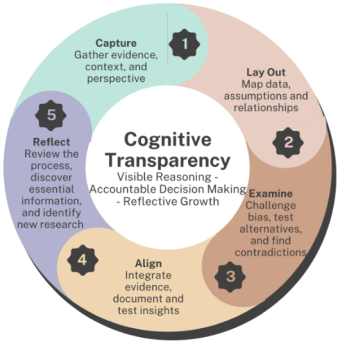
Metacognition, defined as "thinking about thinking," serves as a crucial psychological foundation for the CLEAR Mapping framework. According to Flavell , metacognition enables researchers to track their cognitive processes which leads to better learning results and improved problem-solving abilities. The CLEAR Mapping framework uses metacognitive principles through a structured approach which consists of five stages that start with Capture (identifying known assumptions) followed by Lay Out (mapping relationships and patterns) then Examine (analyzing biases and contradictions) followed by Align (connecting findings with evidence, ethics, and context) and lastly with Reflect (considering implications for learning and action) (See Figure 1.). The structured cycle shows the cognitive processes qualitative researchers use in their work. The CLEAR Mapping method of metacognition follows Kahneman’s dual-process theory which explains how the mind operates through two systems: System 1 (intuitive and fast thinking) and System 2 (analytical and slow thinking). The framework enables researchers to link fast thinking with slow thinking through its method which transforms initial thoughts into complete findings during multiple review stages. The combination of structured thinking with intuitive abilities in CLEAR Mapping enables users to develop better decision skills and reflective thinking abilities which help them detect their cognitive biases and improve the reliability of their interpretations.
Figure 1. The CLEAR Mapping Cycle. Five recursive stages – Capture, Lay Out, Examine, Align, Reflect- encircle a core purpose of Cognitive Transparency. Circular arrows indicate progression; a feedback arrow from Reflect to Capture emphasizes iterative learning.
2.2. Adult Learning & Reflective Practice
CLEAR Mapping situates cognition deeply within the researcher’s context and experience. Adult education founders Knowles and Mezirow determined that adults learn most effectively through hands-on application of their reflective thoughts after they evaluate their existing beliefs. Drawing on this work, CLEAR Mapping supports this process by making meaning-making visible and iterative, allowing researchers to examine how their experiences, values, and social positions influence their interpretations . The model shows how researcher thinking affects team learning environments because reflective thinking often serves as the primary driver for knowledge development. This framework enables researchers to identify and monitor their thought process and collaborative learning environments by extending Schön’s concept of reflection-in-action through a framework that enables individuals to trace their awareness rather than merely reporting findings. This investigative method of reflection establishes a learning space enabling researchers to develop continuously through active exploration of their academic and professional development . The reflective practice method enables researchers to track their cognitive processes which leads to enhanced metacognitive skills and better learning experiences and achievements .
2.3. Metacognition in Qualitative Inquiry
The learning and decision-making processes heavily depend on metacognition because researchers use their cognitive abilities to analyze data in qualitative research. The field of qualitative research needs Clear Mapping as a framework because metacognition lacks proper development and shows inconsistent usage. The framework enables researchers to create an organized system for tracking their mental processes which occur during analysis but end up disorganized in their final reports.
Qualitative researchers perform "metacognitive noticing" by identifying their perceptions, assumptions, and emotional responses as they experience while working with data. During the transcription process researchers often explore their emotional reactions to participant statements, their theoretical frameworks, and new themes which might contradict their first impressions. The Capture stage of CLEAR Mapping enables researchers to record these cognitive events, so they do not disappear from the analytical story. Research evidence supports the practice of documenting these processes because qualitative insights gain more value when researchers document their analytical procedures .
Researchers who conduct qualitative analysis need to track their interpretation processes through metacognitive activities while they observe their understanding development across time. The process of code modification and combination creates uncertainties because data interacts with theoretical preferences and team member influences. The CLEAR framework allows researchers to track their mental conflicts through Lay Out and Examine stages which show how theoretical biases affect interpretation and validate their analysis of data evidence . Researchers can achieve methodological rigor and transparency in qualitative inquiry while monitoring changes in their analytic direction . Qualitative researchers modify their analytical procedures through metacognitive regulation when they identify personal biases, develop overconfidence, or reach hasty conclusions. The process of reviewing transcripts to evaluate new themes and searching for opposing evidence requires researchers to use structured reflective methods. The Align stage of CLEAR framework enables researchers to achieve better regulation through data-based ethical and environmental standard integration which prevents results from being biased . This method enables researchers to study methods for enhancing interpretive depth and managing researcher positionality and biases which can conceal qualitative research findings . The Reflect stage of CLEAR framework helps researchers build meta-metacognition through purposeful evaluation of their mental functions which effect their research work. Researchers must evaluate their core beliefs, weak points, and how personal experiences affect their research decisions and data analysis. The research process of recording reflections helps researchers create detailed descriptions about analytical thinking which move past basic researcher role descriptions and show their detailed research activities . Qualitative research becomes more transparent and ethical through metacognitive process documentation which leads to higher credibility and better interpretive validity. The CLEAR Mapping framework provides qualitative researchers with an organized system to identify their natural metacognitive activities which can be performed without needing to perform extra activity. The method establishes an improved analytical system which generates superior results through its implementation of ethical transparency in qualitative research methods.
2.4. Structured Analytic Tradecraft
The CLEAR Mapping system uses Structured Analytical Techniques principles from intelligence studies to reduce analyst bias which results in more precise outcomes. The Key Assumptions Check and Analysis of Competing Hypotheses (ACH) tools enable practitioners to build their decision-making abilities and their skills in evaluating evidence . The flexible reasoning cycle of CLEAR Mapping transforms SATs into a workable system which enables researchers to conduct structured analysis in qualitative studies and everyday choice situations. The framework lets researchers build their own cognitive workflow system which adapts to personal requirements and environmental conditions instead of forcing them to follow specific methodological rules . The CLEAR Mapping implementation results in improved critical thinking abilities and structured analysis methods which produce higher quality qualitative research findings. The framework enables researchers to study complicated data by using structured analysis methods which follow predetermined methodological procedures. The flexible design of CLEAR Mapping allows users to apply it across different fields and educational settings for developing analytical competencies.
2.5. Recent Directions
Scholarship since 2016 has sharpened guidance on reflexive thematic analysis , trustworthiness and transparent reporting , information power in sampling , and positionality/reflexivity in practice . In parallel, metacognition research supports CLEAR’s emphasis on monitoring and control of cognition. These updates reinforce CLEAR’s role as a method-agnostic, reflexive scaffold that complements contemporary qualitative standards. This article underscores the growing expectation that researchers not only justify methodological choices but also articulate the cognitive and interpretive processes guiding those choices. As the field shifts toward greater transparency, frameworks like CLEAR become increasingly valuable for documenting analytic reasoning in ways that strengthen both rigor and epistemic accountability.
3. The Framework: CLEAR Mapping Cycle
The CLEAR Cycle consists of five sequential stages which help researchers improve their analytical methods and their understanding of their mental operations in qualitative research. The data interpretation process requires researchers to perform systematic work with their cognitive and interpretive frameworks through each stage of the process. This abbreviated breakdown of each stage provides the fundamental knowledge of applying CLEAR to practice or research.
3.1. Stage 1: Capture – Metacognitive Noticing & Reflexive Documentation During Data Collection
The first stage requires researchers to focus on identifying what is known by identifying their existing knowledge, assumptions, beliefs, and emotional reactions by capturing their raw observations and impressions from the data . This includes documenting personal reactions, implicit expectations, and emerging questions that develop during data collection. These “analytic seeds” are rarely captured systematically but often shape data interpretation later in their qualitative process. The CLEAR process systematically addresses this deficiency by requiring researchers to document their initial impressions in the moment of occurrence – during interviews, observations, transcriptions, or initial dataset reviews.
By using CAPTURE in qualitative practice, Capture complements the idea of reflexive attention during data collection . This occurs when the researcher documents the times when the participants response confirms or challenges expectations, when a researcher experiences an emotional response or discomfort, or when outside factors influence meaning-making. While documenting, the researcher identifies these metacognitive entries to create a transparent analytic ground truth to distinguish between what the data shows and how they personally interpret the data. Ethically, researchers must document their impressions alongside data collection techniques to create transparent audit trails that later transforms the interpretive impressions, normally invisible, into a visual reflexive data set that supports analytic rigor .
Example – Education: During interviews, a researcher appends interpretive side notes (e.g. emotional tone, researcher reaction, hunches) in a separate margin to distinguish data from sense-making seeds.
Example – Healthcare: A resident flags uncertainty (e.g. autoimmune vs. infection?) at time-of-note, preserving context for later testing.
3.2. Stage 2: Lay Out – Organize Data, Structuring Codes, and Mapping Relationships
The second research stage requires data organization to establish categories of importance which enable researchers to link different data points. The process moves from initial observations to systemic sense-making. Researchers develop cognitive structures through their analysis of how different concepts relate to each other during this stage. The organizational work enables researchers to categorize excerpts, link concepts, and begin to construct and understand the thematic elements in the data which results in better interpretation of the findings.
CLEAR enhances this stage by having the researcher differentiate:
1) descriptive codes vs. interpretive codes
2) data-driven groupings vs. theory-driven ones
3) strong evidence vs. weak or ambiguous evidence
4) stable patterns vs. outliers or contradictory cases
Researchers gain the ability to understand data relationships improves through proper layout organization of data which results in enhanced interpretation outcomes. This occurs as the structured mapping system allows researchers to create visual diagrams which guard them from making incorrect analytical choices or premature conclusions . By documenting how relationships are identified—and where uncertainty persists—Lay Out increases interpretive transparency and strengthens later theoretical alignment.
Example – Qualitative Coding: Create a matrix distinguishing descriptive vs. interpretative codes and data-driven vs. theory driven groupings; map contradictions.
Example – Intelligence Studies: Build a timeline + link map that connects indicators, sources, credibility and reliability scores.
3.3. Stage 3: Examine – Bias Identification, Contradiction Testing, and Interpretive Vulnerability
The third stage demands researchers to analyze all assumptions, biases, and contradictions which appear in their data collection. Researchers evaluate their cognitive weaknesses through two essential questions- "What am I missing?" and "What might I be wrong about?"- which help them identify their knowledge gaps and potential errors in their thinking.
This stage directly incorporates bias frameworks for qualitative analysis that include:
1) confirmation bias: favoring data that supports expectations
2) anchoring bias: over-relying on early interpretations
3) availability bias: privileging data that are vivid or easily recalled
4) emotional resonance bias: assigning more weight to data that “feels true”
5) theoretical allegiance bias: bending interpretations to fit preferred theories
CLEAR operationalizes bias work by requiring researchers to surface these tendencies explicitly, not merely acknowledge them at the end of the study. The reflective practice development requires this stage because researchers conduct examinations to identify their analytical vulnerabilities. The combination of structured analytical methods with self-assessment techniques leads researchers to generate interpretations that show higher reliability and trustworthiness. Researchers who follow ethical frameworks during their data analysis work can effectively manage their biases while maintaining complete transparency through documented evidence.
Example – Policy: Run an alternative explanations grid comparing at least three rival casual accounts; record what evidence would overturn your leading view.
Example – Organizational Evaluation: Conduct a bias audit huddle where peers name one blind spot they identify in your current memo or program evaluation.
3.4. Stage 4: Align – Integrating Evidence, Theory, Ethics, and Quality Criteria
In the fourth stage, researchers combine their findings with evidence, theoretical knowledge, and ethical principles/standards. Researchers determine which information matches their study data, fundamental values, and the context of their research. The alignment process generates a single unified conceptual and moral coherence which qualitative research needs to establish credibility.
Here, CLEAR integrates qualitative quality criteria, such as:
1) Credibility: Have interpretations been checked against multiple forms of evidence?
2) Dependability: Is the analytic process traceable across cycles of reasoning?
3) Confirmability: Can the researcher demonstrate how interpretations arise from data rather than personal preference?
4) Reflexive integrity: How did positionality shape analytic choices
Align encourages researchers to document and test insights against these criteria from each aspect of their research process, identifying how insights emerge and are tested against their documented and established evidence, further reinforcing the rigor of their process . By documenting this step, the interpretative framework gains strength through its connections which simultaneously defends the analytical results from potential errors. This stage ultimately consolidates the analytical approach and identifies how insights emerged, why they are credible, and how they respond to both data and theory .
Example – EdD Capstone: Use a theory-method alignment matrix tying each research question to constructs, data, analysis, and trustworthiness checks
Example – Hospital: Cross-walk the provisional diagnosis to current guidelines and patient-safety principles; note any value tensions.
3.5. Stage 5: Reflect – Meta-Reflexivity, Learning, and Future Inquiry
The final stage requires a complete review of the research process to discover essential information which will generate new investigation directions based on analytical findings. Researchers need to assess their knowledge development and how their understanding has evolved through the CLEAR Cycle influencing their current study and future work during this meta-reflexivity stage .
CLEAR integrates layers of reflexivity, including:
1) Personal reflexivity: How did identity and experience influence interpretation?
2) Epistemic reflexivity: How did assumptions about knowledge shape analytic moves?
3) Methodological reflexivity: How did the chosen methods structure what became visible or invisible in the data?
4) Relational reflexivity: How did interactions with participants, co-analysts, or stakeholders influence meaning-making?
5) Temporal reflexivity: How did interpretations evolve across analytic cycles?
Researchers who reach the reflective stage of research evaluate all methods in their studies to improve research development and ethical practices through documented processes and structured qualitative research methods . At this stage, CLEAR becomes more than a procedural sequence, it becomes a learning system that strengthens metacognitive capacity, supports ethical inquiry, and enhances qualitative rigor in their academic growth as scholars.
Example – Doctoral Seminar: Close each seminar with a CLEAR Reflection on what changed in the participant thinking, which assumptions moved, and what evidence drove the shift; applicable for doctoral dissertation.
The CLEAR Mapping framework operates as a reflective system and analytical trail which helps researchers understand their thinking processes while providing a method to document their thought development. Researchers who follow the CLEAR Cycle stages with careful attention will produce more transparent and detailed qualitative results which strengthen the credibility and utility of their research findings . CLEAR Mapping functions as both a reflective loop and an analytic audit trail—documenting how researchers and practitioners think, not just what they think.
4. Integration with Qualitative Methodologies
The CLEAR Mapping method operates independently from specific research approaches because it functions as a cognitive overlay which improves current qualitative methods without substituting them (See Table 1). Listed below are a few examples of how CLEAR can be incorporated, this is not all inclusive as CLEAR Mapping for each is customized by the researcher.
Table 1. CLEAR Practical Artifacts Table.

CLEAR Stage

Artifact

Purpose

Capture

Interpretive side-notes template

Separate data from early sensemaking

Lay Out

Code matrix (desc./interp.; data-/theory-driven

Show structure & gaps

Examine

Alternative explanations grid + bias checklist

Stress-test judgments

Align

Theory-Method Alignment Matrix

Demonstrate coherence & quality criteria

Reflect

CLEAR Reflection Memo

Record cognitive shifts & ethics

4.1. Interpretive Phenomenology & Narrative Inquiry
The CLEAR Mapping process enables researchers to track how personal experiences develop into thematic patterns in interpretive phenomenology and narrative inquiry studies. During the Capture stage, researchers record emotional elements and descriptive words from participant stories which helps them understand the depth of human experiences . As researchers reach the Examine stage, they evaluate their entire interpretation process, their positionality regarding the data, and reviewing their research perspective ensuring biases did not influence or create analysis errors . Researchers at the Reflect stage are encouraged to keep a reflexive journal enabling them to connect their data comprehension to their professional obligations of maintaining ethical conduct and personal values in research environments .
4.2. Grounded Theory & Thematic Analysis
CLEAR Mapping aligns naturally with the iterative coding processes of grounded theory . The first stage of "Capturing" raw data directly corresponds to open coding where researchers extract new categories from their collected data . The "Lay Out" and "Examine" steps of the process mirror the axial and selective coding phases which help researchers create logical relationships between different themes and patterns . The "Align" step maintains theoretical coherence of data-derived insights through literature-based validation and empirical evidence, while the Reflect stage demonstrates how grounded theorizing requires researchers to maintain continuous data and interpretation engagement . The research becomes more robust because researchers maintain the iterative dialogue between their data and theory helping them generate more advanced theoretical understanding.
4.3. Case Study & Ethnography
The CLEAR Mapping system enables researchers to create a structured and organized system for note organization during case-based and ethnographic research. The Capture stage allows researchers to detect actual events and observed phenomena and then create interpretive models during the Lay Out stage and align insights with theoretical frameworks or cultural contexts in the Align stage. The CLEAR Mapping method improves qualitative research dependability and confirmability through its systematic process which meets Lincoln and Guba's requirements for qualitative rigor . Researchers who document their analytical steps in detail create more trustworthy results which others can follow to understand their reasoning methods thus building trust in qualitative research.
4.4. Participatory & Improvement Oriented Inquiry
In participatory action research and evaluation contexts, CLEAR Mapping functions as a collaborative reflection model. Research teams use CLEAR Mapping to track their collective reasoning steps which helps them detect any discrepancies between their values, data, and subsequent actions. The method supports teamwork because participants can gain knowledge from each other through their active discussions about data collection and interpretation . The reflective process with stakeholders leads to accessible knowledge generation and participant empowerment by providing agency in the research process. By doing so, researchers can develop more ethically responsible and contextually relevant insights, ultimately leading to beneficial advancements across different disciplines .
The application of CLEAR Mapping across different research methods proves its value as a structural tool which strengthens qualitative research approaches. The CLEAR Mapping system provides researchers with a systematic method to work with data and analytical tools which produces better research outcomes in their respective disciplines.
5. Applied Contexts: Education & Professional Practice
The applicability of CLEAR Mapping extends beyond theoretical research; its utility is particularly pronounced in domains where precise reasoning, interrogative thinking, and transparent decision-making are essential. This is acutely observable in two prominent areas: education and professional/organizational practice. Both spheres benefit immensely from the structured approach that CLEAR Mapping provides, enhancing reflective inquiry and fostering better analytical practices across various learning environments.
5.1. Education Across the Learning Continuum
The CLEAR Mapping system is applicable to provide developmental support to learners at every educational stage from basic research to advanced research training. The formative educational stage of elementary and middle school students who receive support from CLEAR help them express their thinking processes. Students at the Capture stage learn to share their immediate feelings and thoughts which helps them develop their initial observational abilities. Students who progress to the Lay Out stage learn to arrange their thoughts which helps them transform disorganized ideas into structured ones while developing essential learning abilities for future academic success. Students who achieve the Examine phase begin to check reasoning for potential biases and inconsistencies in their concepts. Additionally, the CLEAR method helps teachers convert their feedback into collaborative discussions which follow the principles of the TILT model. The teaching method helps students learn better while encouraging investigative learning instead of memorization according to Cale et al. .
The educational value of CLEAR Mapping extends to high school and undergraduate students. It deepens metacognitive awareness by helping students trace the construction of their arguments, identify gaps in evidence, and connect their interpretations to established disciplinary standards. The structure of CLEAR makes academic writing and research projects and group work activities more effective. Students who understand reasoning development will create better work that becomes more convincing. The tool enables students to handle complex analytical work which develops their critical thinking abilities needed for academic and professional success .
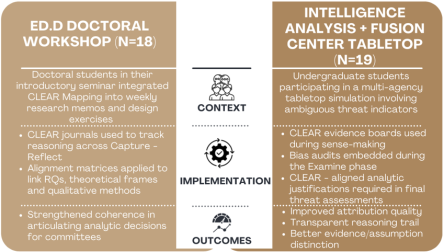
Figure 2. Pilot Applications of the CLEAR Mapping Process in graduate and undergraduate learning environments.
The CLEAR Mapping system functions as a vital methodological reflection tool which graduate students and doctoral candidates need to use. Doctoral researchers who work with complex qualitative data can use CLEAR to create a structured system for documenting their interpretive decisions and maintaining assumption notes while achieving analytical consistency between multiple qualitative inquiry stages. The adaptable nature of CLEAR enables users to implement it with different methodological approaches in qualitative researcher. The system maintains methodological integrity through its ability to create audit trails and its implementation of established research methods. The CLEAR system helps students progress from showing their understanding to showing their thinking processes which creates a base for academic work that requires reflection and rigorous methods (See Figure 2).
5.2. Professional Development, Organizational Practice, and Evaluation
The CLEAR Mapping system enables professionals to develop shared reasoning methods which improve their individual decision-making abilities and team learning outcomes when working under uncertain condition with multiple priorities. The reflective protocol of CLEAR helps professional explains their decision-making steps while showing their hidden beliefs and keeping their actions both ethical and compliant with organizational rules. Leader’s conduct Examine and Align stages to detect value conflicts and evaluate different options which helps them perform ongoing decision assessment instead of treating choices as fixed decisions.
The CLEAR Mapping system enables teams to illustrate how their conclusions emerged from evidence, stakeholder input, and organizational limitations during organizational practice and program evaluation. The visual mapping process helps teams develop better collective reasoning abilities which become accessible for review and learning and improvement purposes. The learning organization principles from Argyris and Schön support this approach because reflection becomes part of action and inquiry helps organizations update their norms instead of defending their choices. The shared analytic language of CLEAR enables diverse practitioners including educators, analysts, health care providers to administrators document their interpretations while adjusting their decisions based on ever changing circumstances.
The CLEAR Mapping system functions as an additional assessment tool which improves current evaluation skills through enhanced assessment capabilities. The system develops analytical competencies through its transparent feedback system which simultaneously improves ethical decision-making and organizational learning abilities. The CLEAR framework helps practitioners build an environment for collaborative development and critical thinking through their dedication to modern qualitative research methods and established practice guidelines .
This CLEAR Mapping system functions as an adaptable framework which helps users develop their qualitative thinking abilities and reflective learning skills in educational and professional environments. The method-agnostic design of CLEAR functions as a fundamental tool which supports learners and professionals during their investigative work and decision-making activities. The CLEAR Mapping system enables better qualitative research understanding through its ethical documentation features which develop analytical skills and professional growth in multiple fields.
6. Conclusions
The CLEAR Mapping system functions as a vital qualitative research instrument because it fulfills the current requirement for methodological transparency and researcher introspection. The framework converts qualitative research reflexivity into a structured research instrument that operates as a continuous process throughout the study, instead of being included as a post–study addition. It treats reasoning as an analyzable element that researchers expose, rather than allowing cognitive processes to remain unobservable foundations. By tracking their cognitive work activities, researchers produce higher-quality results, making CLEAR a method-agnostic design that connects reflexivity to documented analytic practices and modern standards of research rigor.
The main benefit of CLEAR Mapping emerges from its ability to provide researchers with a flexible methodological framework instead of developing new research methods. It enables researchers to achieve transparency within existing design structures while preserving their epistemological approaches. The framework functions as an organizational system that displays reasoning steps across all stages of research, showing how personal values, positionality, and individual perspectives influence evidence collection and interpretation. The educational and professional environments particularly benefit from CLEAR because it develops critical thinking abilities, promotes ethical conduct, and supports team-based reasoning. By allowing researchers to improve their work through personal reflection while also fostering collaborative environments, the framework supports interdisciplinary learning and analytical growth across diverse academic fields.
Qualitative research can use the CLEAR framework to study complex problems because it assists researchers in achieving both detailed interpretation and academic humility. Future research should concentrate on three main topics: integrating CLEAR into digital platforms to support analytic consistency, testing its ability to facilitate communication across research teams, and evaluating its effectiveness within different linguistic and cultural contexts. The CLEAR Mapping system allows researchers to perform active reflexivity analysis, strengthening both the reliability and transformative power of qualitative inquiry while preserving the interpretive richness that defines the field.
Abbreviations

ACH

Analysis of Competing Hypothesis

CLEAR

Capture, Lay Out, Examine, Align, Review

Ed.D.

Educational Doctorate

SAT

Structured Analytical Techniques

TILT

Transparency in Learning and Teaching

Acknowledgments
The author extends sincere appreciation to the Ed.D. doctoral students whose engagement in the CLEAR Mapping workshop informed several of the examples and refinements presented in this article, as well as to the undergraduate students who participated in the CLEAR-based tabletop intelligence exercise. The author also gratefully acknowledges Dr. William Carpenter (University of Miami) for his constructive feedback on early drafts of this manuscript, and the colleagues in the Program of Homeland Security & Emergency Management (Eastern Kentucky University) for their ongoing support of scholarly work.
Author Contributions
Wayne Taylor is the sole author. The author read and approved the final manuscript.
Funding
This work is not supported by any external funding.
Conflicts of Interest
The author declares no conflicts of interest.
References
[1] Lincoln, Y. S., Guba, E. G. Naturalistic Inquiry. Beverly Hills: Sage; 1985.
[2] Tracy, S. J. Qualitative Quality: Eight “Big-Tent” Criteria for Excellent Qualitative Research. Qualitative Inquiry. 2010, 16(10), 837-851.
[3] Glas, A., Soedirgo, J. Reflexive Methodologies and Methods. Oxford Handbook of Engaged Methodological Pluralism in Political Science. 2024,
[4] Mauthner, N. S., Doucet, A. Reflexive Accounts and Accounts of Reflexivity in Qualitative Data Analysis. Sociology. 2003, 37(3), 413-431.
[5] Tomkins, L., Eatough, V. Towards an Integrative Reflexivity in Organisational Research. Qualitative Research in Organizations and Management: An International Journey. 2010, 5(2), 162-181.
[6] Ide, Y., Beddoe, L. Challenging Perspectives: Reflexivity as a Critical Approach to Qualitative Social Work Research. Qualitative Social Work. 2023, 23(4), 725-740.
[7] Morton, J. Ethics Review, Reflective Equilibrium and Reflexivity. Nursing Ethics. 2021, 29(1), 49-62.
[8] Veggel, N. V., Allison, J., Goldspink, S., Engward, H. The Presuppositional Interview as a Means of Transparent Reflexive Practice in Grounded Theory. Methodological Innovations. 2023, 17(1), 31-40.
[9] Bauer, L., Sippel, S. R. Illustrating Qualitative Research Findings: The Reflexive and Epistemic Potential of Experimental Visualization. Geographica Helvetica. 2024, 79(4), 373-389.
[10] Burchill, K. P., Anderson, D. E. The Role of Student Feedback in Building Reflexive Teachers. Handbook of Research on Critical Thinking and Teacher Education Pedagogy. 2019,
[11] Skukauskaitė, A., Trout, İ. Y., Robinson, K. A. Deepening Reflexivity Through Art in Learning Qualitative Research. Qualitative Research. 2021, 22(3), 403-420.
[12] Hilten, A. V. A Novice Reflects on the Research Interview: Reflective Practice and Reflexivity in Research Processes. Qualitative Research in Organizations and Management: An International Journal. 2018, 13(1), 121-122.
[13] Flavell, J. H. Metacognition and Cognitive Monitoring. American Psychologist. 1979, 34(10), 906-911.
[14] Kahneman, D. Thinking, Fast and Slow. New York: Farrar, Straus and Giroux; 2011.
[15] Knowles, M. S. The Modern Practice of Adult Education: From Pedagogy to Andragogy. New York: Cambridge; 1980.
[16] Mezirow, J. Transformative Dimensions of Adult Learning. Jossey-Bass; 1991
[17] Bruno, A., Dell’Aversana, G. Reflective Practice for Psychology Students: The Use of Reflective Journal Feedback in Higher Education. Psychology Learning & Teaching. 2016, 16(2), 248-260.
[18] Garzon, J. R. Metacognitive Inquiry Via Reflective Tasking Methodology. International Journal of Research and Innovation in Social Science. 2023, VII (XI), 1737-1744.
[19] Schön, D. A. The Reflective Practitioner: How Professionals Think in Action. New York: Basic Books; 1983
[20] Teng, M. F., Qin, C., Wang, C. Validation of Metacognitive Academic Writing Strategies and the Predictive Effects on Academic Writing Performance in a Foreign Language Context. Metacognition and Learning. 2021, 17(1), 167-190.
[21] Belenkova, Y. S. Metacognitive Skills and Reflection as Essential Components of Self-Education. MIER Journal of Educational Studies Trends & Practices. 2021, 10(1), 30-46.
[22] Cromley J. G., Kunze, A. Metacognition in Education: Translational Research. Translational Issues in Psychological Science. 2020, 6(1), 15-20.
[23] Jong, S. D., Hasson‐Ohayon, I., Donkersgoed, R. V., Alemán, A., Pijnenborg, G. H. M. A Qualitative Evaluation of the Effects of Metacognitive Reflection and Insight Therapy: ‘Living More Consciously’. Psychology and Psychotherapy: Theory, Research and Practice. 2018, 93(2), 223-240.
[24] Michel, A., Kamudoni, P., Marrel, A., Adiutori, R., Desvignes-Gleizes, C., Lanar, S., Schache, P., Spies, E., Park, J. Integrating Qualitative Interviews in Drug Development and the Use of Qualitative Evidence in Product Labelling and Health Technology Assessments: A Review. Frontiers in Medicine. 2023, 10.
[25] Sterie, A., Potthoff, S., Erdmann, A., Burner-Fritsch, I., Aluh, D., Schneiders, M. Dimensions of Researcher Vulnerability in Qualitative Health Research and Recommendations for Future Practice. International Journal of Qualitative Methods. 2023, 22.
[26] Wolgemuth, J. R. Analyzing for Critical Resistance in Narrative Research. Qualitative Research. 2013, 14(5), 586-602.
[27] Squires, A., Dorsen, C. Qualitative Research in Nursing and Health Professions Regulation. Journal of Nursing Regulation. 2018, 9(3), 15-26.
[28] Hammersley, M., Traianou, A. An Alternative Ethics? Justice and Care as Guiding Principles for Qualitative Research. Sociological Research Online. 2014, 19(3), 104-117.
[29] Cutcliffe, J. R., Ramcharan, P. Leveling the Playing Field? Exploring the Merits of the Ethics-As-Process Approach for Judging Qualitative Research Proposals. Qualitative Health Research. 2002, 12(7), 1000-1010.
[30] Heuer, R. J., Pherson, R., H. Structured Analytic Techniques for Intelligence Analysis. CQ Press, 2010.
[31] Dunlap, J. C., Grabinger, S. Preparing Students for Lifelong Learning: A Review of Instructional Features and Teaching Methodologies. Performance Improvement Quarterly. 2008, 16(2), 6-25.
[32] Braun, V., & Clarke, V. (2019). Reflecting on Reflexive Thematic Analysis. Qualitative Research in Sport, Exercise and Health, 11(4), 589–597.
[33] Braun, V., & Clarke, V. (2020). One Size Fits All? What Counts as Quality Practice in (Reflexive) Thematic Analysis? Qualitative Research in Psychology, 18(3), 328–352.
[34] Levitt, H. M., Bamberg, M., Creswell, J. C., Frost, D. M., Josselson, R., Suárez-Orozco, C. (2018). Journal Article Reporting Standards for Qualitative Primary, Qualitative Meta-Analytic, and Mixed Methods Research in Psychology: The APA Publications and Communications Board Task Force Report. American Psychologist, 73(1), 26–46.
[35] Nowell, L. S., Norris, J. M., White, D. E., & Moules, N. J. (2017). Thematic Analysis: Striving to Meet the Trustworthiness Criteria: Striving to Meet the Trustworthiness Criteria. International Journal of Qualitative Methods, 16(1).
[36] Malterud K, Siersma VD, Guassora AD. Sample Size in Qualitative Interview Studies: Guided by Information Power: Guided by Information Power. Qualitative Health Research. 2015; 26(13): 1753-1760.
[37] Dodgson JE. Reflexivity in Qualitative Research. Journal of Human Lactation. 2019; 35(2): 220-222.
[38] Holmes, A. G. D. (2020). Researcher Positionality—A Consideration of its Influence. International Journal of Education, 8(4), 1–10.
[39] Efklides, A. (2014). How Does Metacognition Contribute to the Regulation of Learning? An Integrative Approach. Psihologijske teme, 23(1), 1-30.
[40] Zohar, A., & Barzilai, S. (2013). A Review of Research on Metacognition in Sience Education: Current and Future Directions. Studies in Science Education, 49(2), 121–169.
[41] Azevedo, R., Aleven, V. (2013). Metacognition and Learning Technologies: An Overview of Current Interdisciplinary Research. In: Azevedo, R., Aleven, V. (eds) International Handbook of Metacognition and Learning Technologies. Springer International Handbooks of Education, vol 28. Springer, New York, NY.
[42] Hamati-Ataya, I. Reflectivity, Reflexivity, Reflexivism: IR’s ‘Reflexive Turn’ – and Beyond. 2012, 19(4), 669-694.
[43] Tsekeris, C., Koskinas, K. A “Weak” Reflection on Unpredictability and Social Theory. TripleC: Communication, Capitalism, & Critique. Open Access Journal for a Global Sustainable Information Society. 2010, 8(1), 36-42.
[44] Berger, R. Now I See It, Now I Don’t: Researcher’s Position and Reflexivity in Qualitative Research. Qualitative Research. 2013, 15(2), 219-234.
[45] Vargas-Hernández, J. G., González, F. J., G., Vargas-González, O. C. Organizational Ethnography Research and its Implications in the Analysis of Organizational and Managerial Studies. Advances in Knowledge Acquisition, Transfer, and Management. 2024, 205-224.
[46] Nair, L. B. From ‘Whodunit’ to ‘How’: Detective Stories and Auditability in Qualitative Business Ethics Research. Journal of Business Ethics. 2020, 172(2), 195-209.
[47] Islam, M. S. Expanding the Qualitative Repertoire in Organizational Research: A Framework for Hybrid Reflexive Narrative Inquiry. Journal of Trade Science. 2025, 1-23.
[48] Stronach, I., Garratt, D., Pearce, C. G., Piper, H. Reflexivity, the Picturing of Selves, the Forging of Method. Qualitative Inquiry. 2007, 13(2), 179-203.
[49] Braund, H., Turnnidge, J., Cofie, N., Kuforiji, O., Greco, S., Hastings-Truelove, A., Hill, S., Dalgarno, N. Six Ways to Get a Grip on Developing Reflexivity Statements. Canadian Medical Journal. 2024, 15(5), 146-149.
[50] Manen, M. V. But is it Phenomenology? Qualitative Health Research. 2017, 27(6), 775-779.
[51] Öhlén, J., Friberg, F. Empirical Phenomenological Inquiry: Guidance in Choosing Between Different Methodologies. Global Qualitative Nursing Research. 2023, 10.
[52] Mello, J., Flint, D. J. A Refined View of Grounded Theory and its Application to Logistics Research. Journal of Business Logistics. 2009, 30(1), 107-125.
[53] Charmaz, K. Constructing Grounded Theory. 2nd Ed. London: Sage, 2014.
[54] Charmaz, K. The Power of Constructivist Grounded Theory for Critical Inquiry. Qualitative Inquiry. 2016, 23(1), 34-45.
[55] Kelly, K. P., Knafl, K. A., Keller, S., Hinds, P. S. Thematic Expansion: A New Strategy for Theory Development. Western Journal of Nursing Research. 2021, 43(10), 962-971.
[56] Naem, M., Ozuem, W., Howell, K. E., Ranfagni, S. A Step-By-Step Process of Thematic Analysis to Develop a Conceptual Model in Qualitative Research. International Journal of Qualitative Methods. 2023, 22.
[57] Miksza, P., Shaw, J. T., Richerme, L. K., Hash, P. M., Hodges, D. A., Parker, E. C. Additional Qualitative Approaches. Music Education Research. 2023, 183-216.
[58] Eaves, Y. D. A Synthesis Technique for Grounded Theory Data Analysis. Journal of Advanced Nursing. 2001, 35(5), 654-663.
[59] Leggo, C. Narrative Inquiry: Honoring the Complexity of the Stories We Live. Brock Education Journal. 2004, 14(1).
[60] Lomborg, K., Kirkevold, M. Truth and Validity in Grounded Theory – A Reconsidered Realist Interpretation of the Criteria: Fit, Work, Relevance and Modifiability. Nursing Philosophy. 2003, 4(3), 189-200.
[61] Cale, A., Hoffman, L. A., McNulty, M. A. Promoting Metacognition in an Allied Health Anatomy Course. Anatomical Sciences Education. 2022, 16(3), 473-485.
[62] Lim, W. M. What is Qualitative Research? An Overview and Guidelines. Australasian Marketing Journal. 2025, 33(2), 199-229.
[63] Mitsea, E., Drigas, A. A Journey into the Metacognitive Learning Strategies. International Journal of Online and Biomedical Engineering. 2019, 15(14), 4-20.
[64] Argyris, C., Schön, D. Organizational Learning: A Theory of Action Perspective. Addison-Wesley, 1978.
[65] Cousin, G., Reflexivity: The New Reflective Practice. International Journal of Practice-Based Learning in Health and Social Care. 2013, 1(2), 3-7.
Cite This Article
  • APA Style

    Taylor, W. (2025). CLEAR Mapping: A Meta-Cognitive Framework for Transparent, Reflexive, and Evidence-Aware Qualitative Analysis. Social Sciences, 14(6), 610-621. https://doi.org/10.11648/j.ss.20251406.15

    Copy | Download

    ACS Style

    Taylor, W. CLEAR Mapping: A Meta-Cognitive Framework for Transparent, Reflexive, and Evidence-Aware Qualitative Analysis. Soc. Sci. 2025, 14(6), 610-621. doi: 10.11648/j.ss.20251406.15

    Copy | Download

    AMA Style

    Taylor W. CLEAR Mapping: A Meta-Cognitive Framework for Transparent, Reflexive, and Evidence-Aware Qualitative Analysis. Soc Sci. 2025;14(6):610-621. doi: 10.11648/j.ss.20251406.15

    Copy | Download

  • @article{10.11648/j.ss.20251406.15,
      author = {Wayne Taylor},
      title = {CLEAR Mapping: A Meta-Cognitive Framework for Transparent, Reflexive, and Evidence-Aware Qualitative Analysis},
      journal = {Social Sciences},
      volume = {14},
      number = {6},
      pages = {610-621},
      doi = {10.11648/j.ss.20251406.15},
      url = {https://doi.org/10.11648/j.ss.20251406.15},
      eprint = {https://article.sciencepublishinggroup.com/pdf/10.11648.j.ss.20251406.15},
      abstract = {This methodological innovation article provides a brief introduction of CLEAR Mapping (Capture–Lay Out–Examine–Align–Reflect) as a flexible framework designed to enhance transparent, bias-aware reasoning in qualitative and applied inquiry. CLEAR makes thinking visible by structuring how researchers, educators, and practitioners document evidence, interrogate assumptions, and align interpretations with theory, ethics, and situational context. Grounded in cognitive psychology, adult learning, and structured analytic tradecraft, CLEAR integrates intuitive and deliberative cognition to support decision-making under uncertainty while balancing creativity with methodological discipline and ethical restraint. The paper (a) specifies the five-stage CLEAR cycle and its cognitive aims; (b) demonstrates domain-specific applications in education, intelligence, healthcare, and organizational evaluation; and (c) outlines pedagogical uses—such as e-portfolios, bias audits, signature-mapping, and alignment matrices—that enhance rigor and reflexivity, and metacognitive growth. In addition to a diagram of the CLEAR cycle, the paper presents brief pilot studies and instructional prototypes that illustrate feasibility, utility, and scalability across contexts. CLEAR is method-agnostic and complements prevailing qualitative traditions by adding a traceable reasoning trail that strengthens credibility, confirmability, and ethical accountability. The article concludes with implementation guidance, adoption considerations for instructional and professional environments, and future research directions related to bias reduction, cognitive transparency, and the role of human–AI collaboration in reflective analysis and judgment formation.},
     year = {2025}
    }
    

    Copy | Download

  • TY  - JOUR
    T1  - CLEAR Mapping: A Meta-Cognitive Framework for Transparent, Reflexive, and Evidence-Aware Qualitative Analysis
    AU  - Wayne Taylor
    Y1  - 2025/12/26
    PY  - 2025
    N1  - https://doi.org/10.11648/j.ss.20251406.15
    DO  - 10.11648/j.ss.20251406.15
    T2  - Social Sciences
    JF  - Social Sciences
    JO  - Social Sciences
    SP  - 610
    EP  - 621
    PB  - Science Publishing Group
    SN  - 2326-988X
    UR  - https://doi.org/10.11648/j.ss.20251406.15
    AB  - This methodological innovation article provides a brief introduction of CLEAR Mapping (Capture–Lay Out–Examine–Align–Reflect) as a flexible framework designed to enhance transparent, bias-aware reasoning in qualitative and applied inquiry. CLEAR makes thinking visible by structuring how researchers, educators, and practitioners document evidence, interrogate assumptions, and align interpretations with theory, ethics, and situational context. Grounded in cognitive psychology, adult learning, and structured analytic tradecraft, CLEAR integrates intuitive and deliberative cognition to support decision-making under uncertainty while balancing creativity with methodological discipline and ethical restraint. The paper (a) specifies the five-stage CLEAR cycle and its cognitive aims; (b) demonstrates domain-specific applications in education, intelligence, healthcare, and organizational evaluation; and (c) outlines pedagogical uses—such as e-portfolios, bias audits, signature-mapping, and alignment matrices—that enhance rigor and reflexivity, and metacognitive growth. In addition to a diagram of the CLEAR cycle, the paper presents brief pilot studies and instructional prototypes that illustrate feasibility, utility, and scalability across contexts. CLEAR is method-agnostic and complements prevailing qualitative traditions by adding a traceable reasoning trail that strengthens credibility, confirmability, and ethical accountability. The article concludes with implementation guidance, adoption considerations for instructional and professional environments, and future research directions related to bias reduction, cognitive transparency, and the role of human–AI collaboration in reflective analysis and judgment formation.
    VL  - 14
    IS  - 6
    ER  - 

    Copy | Download

Author Information
  • Safety & Security, Eastern Kentucky University, Richmond, United States of America

    Biography: Wayne Taylor is an Assistant Professor at Eastern Kentucky University, Safety & Security Department. He holds an Ed.D. in Program Development from the University of South Florida, multiple graduate certificates in education, diversity, and qualitative research, and a Ph.D. Candidate in Interdisciplinary Education. Dr. Taylor's current work blends academic scholarship with practical leadership, preparing students for careers in homeland security, intelligence, and public service.

    Research Fields: Applied Learning, Qualitative Research, Ethical Intelligence Education, Adult Learning & Development, Veteran Studies

  • Abstract
  • Keywords
  • Document Sections

    1. 1. Introduction
    2. 2. Theoretical Foundations
    3. 3. The Framework: CLEAR Mapping Cycle
    4. 4. Integration with Qualitative Methodologies
    5. 5. Applied Contexts: Education & Professional Practice
    6. 6. Conclusions
    Show Full Outline
  • Abbreviations
  • Acknowledgments
  • Author Contributions
  • Funding
  • Conflicts of Interest
  • References
  • Cite This Article
  • Author Information